
The integrity of a democratic nation rests fundamentally on the unassailable credibility of its electoral processes. In a contemporary global landscape marked by a steady erosion of democratic standards, the institutions responsible for conducting free and fair elections face unprecedented scrutiny.
Elite abuses of power, complex structural crises, and a global shift wherein authoritarian regimes are gaining ground have resulted in a precarious situation where the normative goalposts of democracy are losing stability. Recent global reports indicate a stark reversal in the ratio of democracies to autocracies, with 56 percent of surveyed countries now ruled autocratically, underscoring the fragility of democratic institutions. Against this volatile international backdrop, the Election Commission of India , traditionally heralded as a global gold standard for electoral administration, has found itself at the epicenter of intense political and judicial debate.
Questions surrounding the commission’s transparency, its independence from the political executive, and its overall accountability have begun to surface with increasing frequency. Recent political discourse has been dominated by allegations of voter fraud and manipulation. For instance, the political opposition recently raised serious claims regarding mass fictitious voter entries and unexplained voting arithmetic anomalies in specific constituencies, such as Mahadevapura in Bangalore, where the ruling party’s lead allegedly surged from around 44,500 to over 114,000 votes amid modest turnout increases. Additional allegations pointed to duplicate Electoral Photo Identity Card (EPIC) numbers and systemic exclusions.
While the factual veracity of every such allegation remains a matter of formal judicial and administrative inquiry, the mere existence and proliferation of these controversies create fertile ground for public suspicion. This necessitates a deep, analytical examination of the Election Commission of India—tracing its conceptual origins, its constitutional mandate, historical evolution, and the ongoing legal battles that will decisively shape the future of the world’s largest democracy.
The Conceptual Origination and Global History of Elections
To fully comprehend the modern electoral framework, one must trace the global evolution of the concept of elections. The practice of voting has its earliest roots in the ancient city-state of Athens and the Roman Republic, though these early systems often relied heavily on sortition—the selection of public officials by lot—as elections were sometimes viewed with suspicion as oligarchic institutions.
The contemporary model of elections emerged gradually alongside the rise of representative government in seventeenth-century Europe and North America. During this transformative era, the medieval notion of representation based on estates, corporations, and vested interests transitioned into a more individualistic framework, establishing the individual citizen as the critical unit of political power. This philosophical shift catalyzed massive sociopolitical movements for broader suffrage, culminating in landmarks like the British Reform Act of 1832, which abolished “rotten boroughs”—small electoral districts controlled by single aristocratic families—and significantly expanded the electorate. Over time, the foundational democratic principle that governments derive their legitimacy solely from the consent of the governed became the bedrock of modern nation-states, requiring regular, competitive elections.
In the Indian context, the trajectory of electoral democracy predates the nation’s independence in 1947. The British colonial administration introduced nascent electoral frameworks through sequential legislative acts. The Government of India Act of 1919 marked a significant turning point by introducing a bicameral central legislature, initiating direct elections, and establishing the system of “diarchy” at the provincial level. Under this Act, 70 percent of the members of provincial legislative councils were to be elected, and political consciousness began to permeate the Indian populace on an unprecedented scale, laying the groundwork for mass political mobilization.
This framework was further expanded by the Government of India Act of 1935, which granted provincial autonomy and eliminated the diarchy system at the provincial level. The 1935 Act reduced property thresholds to allow women and marginalized groups to vote, expanding the franchise to roughly 35 million people, and initiated structural reorganizations such as separating Burma and Aden from India. Though highly restricted compared to the universal adult suffrage of today, these legislative milestones laid the indispensable administrative and political groundwork for the monumental electoral exercises of post-independence India.

(Source: SB Stock / Getty Images)
Establishment and Evolution of the Election Commission of India
Recognizing that the survival of the nascent republic depended entirely on an independent, non-partisan electoral mechanism, the framers of the Indian Constitution established the Election Commission of India on January 25, 1950. Operating from its headquarters at Nirvachan Sadan in New Delhi, the ECI was envisioned as a constitutionally mandated, autonomous body empowered to conduct, control, and supervise elections to the Parliament, state legislatures, and the highest constitutional offices of the President and Vice President.
Initially, the ECI functioned as a single-member body comprising solely the Chief Election Commissioner (CEC). However, the growing complexity and sheer demographic explosion of the Indian electorate necessitated structural expansion. In 1989, two additional commissioners were appointed for a brief period, and by 1993, the ECI permanently transformed into a three-member body comprising one CEC and two Election Commissioners (ECs).
The scale at which the ECI operates is unparalleled globally, representing the largest management event in the world. In the late 1990s, the electorate exceeded 605 million people voting across roughly 800,000 polling stations. By the 2024 general elections, this number had swelled to over 968 million registered voters across 1.05 million polling stations. The commission operates with a core secretariat of around 300 to 550 permanent personnel, but to manage the logistical leviathan of general elections, it deploys millions of temporary civil and police officials to ensure seamless administration across diverse geographic extremes, from the snow-clad Himalayas to the deserts of Rajasthan and remote island territories.
Constitutional Provisions Governing Elections in India
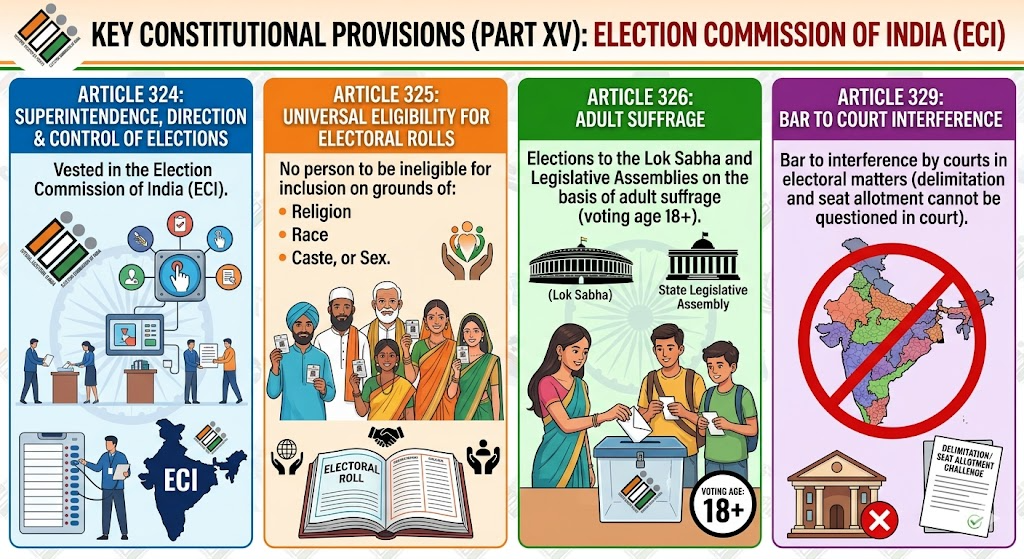
The legal and operational framework ensuring the democratic process is deeply embedded in Part XV of the Constitution of India, which explicitly outlines the architecture of electoral governance through Articles 324 to 329.
Article 324 is the foundational bedrock of the ECI’s authority. It vests the comprehensive powers of “superintendence, direction, and control” of all national and state elections directly in the Election Commission. This sweeping mandate was designed to empower the institution to function autonomously and proactively, theoretically immune from the political pressures of the ruling executive branch.
Article 325 guarantees secular and egalitarian representation. It mandates the creation of a single, general electoral roll for every territorial constituency and explicitly prohibits the disenfranchisement of any citizen, or the creation of special electoral rolls, on the grounds of religion, race, caste, or sex.
Article 326 establishes the revolutionary principle of universal adult suffrage. It declares that elections to the House of the People (Lok Sabha) and the Legislative Assemblies of States shall be based on the voting rights of all adult citizens. In a newly independent nation characterized by massive diversity, high illiteracy, and deep socioeconomic divides, granting immediate universal adult suffrage was a profoundly radical and progressive democratic leap.
Article 327 and Article 328 demarcate the respective legislative powers regarding the electoral process. Article 327 empowers the national Parliament to enact laws pertaining to the preparation of electoral rolls, the delimitation of constituencies, and all other matters necessary to secure the due constitution of the legislatures. This constitutional power led to the enactment of foundational statutes like the Representation of the People Acts (RPA) of 1950 and 1951, as well as the Delimitation Act. Article 328 grants supplementary powers to State Legislatures to make provisions for state-level elections, strictly subject to the overarching laws made by Parliament.
Finally, Article 329 is designed to prevent judicial interference from indefinitely stalling the electoral process. It establishes a strict bar against courts intervening in electoral matters, stipulating that the validity of delimitation laws cannot be questioned in any court, and election disputes can only be challenged through formal election petitions presented to an authority provided by law after the electoral process has concluded.
The Constituent Assembly Debates: The Struggle for Institutional Independence
The profound autonomy granted to the ECI was not a foregone conclusion; rather, it was the product of intense, nuanced deliberation within the Constituent Assembly. When Draft Article 289 (which later became Article 324) was debated in June 1949, the framers wrestled with a critical dilemma: how to effectively insulate the electoral machinery from the political executive while simultaneously managing the immense administrative and logistical demands of holding elections across a subcontinent.
Dr. B.R. Ambedkar, the chief architect of the Constitution, stressed that the election machinery must remain entirely outside the control of the executive government to prevent ruling parties from manipulating the democratic process to retain power. Assembly members like Shibban Lal Saksena expressed grave concerns over executive overreach, proposing a structural amendment requiring that all appointments to the Election Commission receive parliamentary approval by a two-thirds majority. Similarly, H.N. Kunzru argued passionately that the integrity of the electoral machinery was paramount, warning that if the individuals administering elections lacked unassailable integrity, “democracy will be poisoned at the source”.
Conversely, K.M. Munshi, a prominent member of the Drafting Committee, offered a highly pragmatic counter-view. He argued that because elections in India constitute such a massive administrative exercise, they must inevitably be conducted utilizing existing government machinery, making complete operational separation from the executive state practically impossible.
To reconcile these differing viewpoints, Dr. Ambedkar proposed a compromise strategy known as “constitutional deferral.” Article 324(2) was finalized to state that the President would appoint the CEC and ECs, but crucially, this power would be “subject to the provisions of any law made in that behalf by Parliament”. The framers intentionally left the exact appointment mechanism to the discretion of a future Parliament, trusting that lawmakers would eventually enact comprehensive legislation to formally insulate ECI appointments from unilateral executive dominance.
Decades of Committees and Electoral Reforms
For over seven decades following the adoption of the Constitution, Parliament did not enact the specific law envisioned by Dr. Ambedkar. Consequently, the executive continued to appoint Election Commissioners based primarily on the advice of the Prime Minister and the Council of Ministers. Over the years, the growing complexities of Indian politics—including the criminalization of politics, the massive infusion of illicit money, and allegations of institutional partisanship—prompted multiple high-level committees to recommend comprehensive electoral reforms.
The Tarkunde Committee, formed by civil rights leader Jayaprakash Narayan in 1974, was one of the earliest to suggest significant changes, including making the ECI a permanent multi-member body and altering the appointment process to actively dilute executive dominance. Decades later, the landmark Dinesh Goswami Committee on Electoral Reforms in 1990 explicitly recommended that the CEC should be appointed by the President in consultation with the Chief Justice of India and the Leader of the Opposition. This represented one of the earliest official governmental endorsements of a collegium-like system designed to neutralize political bias.
In 1993, the Vohra Committee was constituted following the devastating Bombay bomb blasts to investigate the criminalization of politics. Its explosive report exposed a deeply entrenched nexus between politicians, bureaucrats, and criminal syndicates, specifically highlighting how illicit money was utilized to develop muscle power networks to influence electoral outcomes and capture polling booths. The findings underscored the urgent need for a robust, independent ECI capable of combating the severe threats posed by mafia organizations infiltrating the democratic system.
Furthering the call for reform, the Law Commission of India, through its 170th (1999), 244th (2014), and 255th (2015) Reports, consistently advocated for systemic electoral changes. The comprehensive 255th Report proposed wide-ranging reforms regarding candidate expenditure limits, political finance disclosures, and strongly reiterated the recommendation for a collegium system for ECI appointments comprising the Prime Minister, the Leader of the Opposition, and the CJI, arguing that executive monopoly over appointments undermined public trust.
Appointments, Tenure, and Service Conditions
Understanding the ongoing controversies requires examining the specific parameters of ECI appointments and service conditions. Historically, appointees have predominantly been senior bureaucrats drawn from the Indian Civil Services. The CEC and the other ECs are appointed for a fixed tenure of six years, or until they attain the age of 65 years, whichever is earlier.
A critical structural asymmetry exists regarding their removal process. Under the Constitution, the Chief Election Commissioner is granted security of tenure equivalent to a Supreme Court Judge and can only be removed from office through a rigorous parliamentary impeachment process on grounds of proven misbehavior or incapacity. However, the other Election Commissioners do not enjoy this explicit constitutional protection; they can be removed by the President simply upon the recommendation of the CEC. This asymmetry has long been criticized by legal experts as a vulnerability that could be exploited to coerce Election Commissioners.
Furthermore, prior to recent legislative changes, the salary and perks of all commissioners were explicitly equated to those of a Supreme Court Judge, reinforcing their elevated constitutional status.
The Landmark 2023 Supreme Court Judgment
The prolonged “constitutional vacuum” regarding ECI appointments finally reached a boiling point in the Supreme Court of India. In a Public Interest Litigation (Anoop Baranwal v. Union of India) filed in 2015, the petitioner argued that the executive’s unilateral power to appoint the CEC and ECs fundamentally undermined the institution’s independence, violated Article 14 of the Constitution (right to equality), and compromised the democratic guarantee of free and fair elections.
The Union Government vigorously defended the existing system, arguing that the Constitution explicitly conferred the appointment power to the President (acting on executive advice) and urged the judiciary to respect the strict separation of powers. The government maintained that the track record of past commissioners was highly honest and that there was no legitimate trigger for judicial intervention into what it deemed an exclusive executive domain.
On March 2, 2023, a five-judge Constitution Bench led by Justice K.M. Joseph delivered a unanimous, historic verdict. The Court meticulously analyzed the Constituent Assembly Debates, affirming that an arrangement where the executive exclusively controls appointments to an institution meant to independently oversee that very executive is inherently antithetical to democratic neutrality.
Invoking its extraordinary powers under Article 142 to fill the legislative void, the Supreme Court established an interim mechanism. It mandated that the appointment of the CEC and ECs must be made by the President on the binding advice of a three-member Selection Committee consisting of:
- The Prime Minister
- The Leader of the Opposition in the Lok Sabha (or the leader of the single largest opposition party)
- The Chief Justice of India
In a vital concurring opinion, Justice Ajay Rastogi added that to further secure institutional independence, Election Commissioners must be afforded the exact same protections against removal as the Chief Election Commissioner, insulating the entire body from external political interference.
The 2023 CEC Act and Ongoing Legal Battles
The Supreme Court had explicitly stated that its collegium mechanism was a temporary measure intended to operate only until Parliament enacted its own comprehensive law under Article 324(2). The government reacted swiftly by introducing The Chief Election Commissioner and Other Election Commissioners (Appointment, Conditions of Service and Term of Office) Bill, 2023, which was subsequently passed by Parliament in December 2023.
The 2023 Act radically altered the appointment architecture established by the judiciary. While it maintained a three-member Selection Committee, it conspicuously replaced the Chief Justice of India with a Union Cabinet Minister nominated by the Prime Minister. It also introduced a Search Committee, headed by the Cabinet Secretary, to propose a panel of names.
Structural Shifts and Key Criticisms
The passage of the Act drew severe criticism from democratic reform advocates, civil society organizations, and constitutional experts, leading to immediate legal challenges. The structural changes can be visualized as follows:
| Feature | Pre-2023 Executive Practice | Supreme Court 2023 Judgment | 2023 CEC Act |
| Selection Committee | Solely the Executive advising the President. | Prime Minister, Leader of Opposition, Chief Justice of India. | Prime Minister, Cabinet Minister, Leader of Opposition. |
| Balance of Power | Complete Executive control. | Balanced (Executive, Legislative Opposition, Judiciary). | Executive Dominance (2:1 majority for the ruling party). |
| Salary and Status | Equivalent to a Supreme Court Judge. | Not altered. | Downgraded to equivalent of Cabinet Secretary. |
| Committee Validity | N/A | Required consensus or majority of the three. | Valid even if there is a vacancy (e.g., no Leader of Opposition). |
The structural downgrade of the ECI’s status from equivalence with Supreme Court Judges to that of a Cabinet Secretary carries profound implications. Since the ECI frequently performs quasi-judicial functions—such as adjudicating high-stakes disputes over political party symbols and ruling on the disqualification of Members of Parliament—equating their status to career bureaucrats subtly subordinates them to the executive apparatus. A judge’s salary is secured by an independent Act of Parliament, whereas a Cabinet Secretary’s salary is dictated by the government, creating a mechanism for indirect executive influence.
Furthermore, the 2:1 majority of the ruling party on the Selection Committee effectively restores the executive dominance that the Supreme Court’s 2023 judgment explicitly sought to curtail. Critics, including the Association for Democratic Reforms (ADR), have argued in court that this legislation nullifies the constitutional guarantee of institutional autonomy by rendering the Leader of the Opposition a mere spectator in the appointment process.
Current Case Status (May 2026)
The constitutional validity of the 2023 Act is currently sub-judice before the Supreme Court. Multiple petitions, including those filed by Jaya Thakur and the ADR (Jaya Thakur v. Union of India), are actively being heard as of May 2026.
In critical hearings conducted on May 6 and 7, 2026, a bench comprising Justices Dipankar Datta and Satish Chandra Sharma underscored the immense gravity of the issue. The bench outright refused a request by the Solicitor General to adjourn the ECI hearings in favor of a separate nine-judge Constitution bench matter, with Justice Datta firmly stating, “This matter is more important than any other matter”.
During the proceedings, the Court noted that the CJI’s inclusion in the March 2023 judgment was genuinely intended as an interim stop-gap until Parliament acted. However, senior advocates representing the petitioners countered that while Parliament undeniably possesses the right to legislate, creating a law that intentionally restores executive hegemony over a constitutional watchdog violates the basic structure of the Constitution and the fundamental right to free and fair elections. The ultimate outcome of this ongoing litigation will decisively shape the future independence of India’s electoral machinery.
Practical Challenges in Electoral Administration
Beyond the high-profile appointment controversies, the Election Commission of India grapples daily with immense operational, technological, and ethical challenges in executing elections. Three prominent issues have dominated recent electoral cycles: the verification of electronic votes, the opacity of political finance, and the enforcement of campaign ethics.
EVMs improved Indian elections by reducing booth capturing and ballot-box stuffing common in the paper ballot system, but they also created concerns about hacking and manipulation. To increase trust, the ECI introduced VVPAT in 2013 so voters can see a printed slip of their vote. In 2024, petitions demanded 100% VVPAT verification with EVM results, but the ECI argued that only five polling stations per constituency can be checked due to major delays. The Supreme Court rejected full verification but ordered stronger technical safeguards, including securing EVM microcontroller units.
Political funding is another serious issue because black money influences elections. In 2018, the Electoral Bond Scheme allowed anonymous corporate donations, but the ECI and RBI opposed it for reducing transparency. On February 15, 2024, the Supreme Court struck it down as unconstitutional, holding that hiding donor identities violates the Right to Information under Article 19(1)(a) and encourages corruption. The ECI was directed to publish donor details, but problems still remain due to untraceable cash donations and weak financial auditing of political parties.
Enforcing the Model Code of Conduct also raises bias allegations, especially against powerful leaders. During the 2024 elections, the ECI issued notices to both BJP and Congress presidents over controversial speeches, including by senior leaders. Though the ECI claimed it resolved over 90% of complaints, critics say it fails to act strongly and quickly in real time. At the same time, AI-based deepfakes and online misinformation have created new challenges that the traditional MCC is not fully prepared to handle.
Securing the Democratic Future: A Way Forward
The legitimacy of a democracy hinges entirely on the perceived and actual neutrality of its electoral referees. As the ECI navigates these turbulent constitutional and technological waters, several critical structural reforms are necessary to fortify its independence:
First, revisiting the selection matrix is paramount. The current structure under the 2023 Act heavily favors the political executive. To ensure absolute neutrality, the selection committee must be structurally balanced. Reintroducing an impartial entity—such as the Chief Justice of India or creating a consensus-driven multi-party panel—is essential to prevent the ECI from operating as a subordinate organ of the ruling government.
Second, there must be equal protection of tenure for all commissioners. Currently, only the Chief Election Commissioner holds constitutional protection against arbitrary removal. Extending the same rigorous parliamentary impeachment protections to all Election Commissioners is vital to insulate them from subtle political coercion.
Third, the establishment of an independent secretariat is crucial. Like the Lok Sabha, the Rajya Sabha, and the Supreme Court, the ECI must manage its own administrative affairs. Relying on government-appointed bureaucrats and Ministry of Law funding structures inherently creates a dependency that can be leveraged politically. Charging ECI expenditures directly to the Consolidated Fund of India would secure complete administrative and financial autonomy.
Finally, modernizing disinformation protocols and enforcing comprehensive political finance auditing must become regulatory priorities. Formulating stringent, rapid-response regulations for AI-generated disinformation and mandating the independent auditing of all political party finances will drastically reduce the incentive for crony capitalism and the continued criminalization of politics.
The Election Commission of India is not merely an administrative body , it is the constitutional guardian of the political sovereignty of nearly a billion citizens. The historical journey of the ECI—from the philosophical debates of the Constituent Assembly to the modern-day logistical marvel of managing the world’s largest democratic exercise—underscores its foundational importance. However, the current intersection of judicial intervention and legislative pushback has brought the institution to a critical inflection point.
Ensuring that the Election Commission of India remains fiercely independent, financially autonomous, and technologically progressive is a profound democratic imperative. Addressing the structural vulnerabilities identified by constitutional experts, the judiciary, and civil society will ensure that India’s democratic heartbeat continues to resonate with clarity, fairness, and global authority for decades to come.
For more insights on law, governance, public policy, and current affairs, visit thinkingthorough.com
References
Constitution of India. (n.d.). Part XV Archives – Constitution of India. https://www.constitutionofindia.net/parts/part-xv/
Election Commission of India. (n.d.). Drishti IAS. https://www.drishtiias.com/daily-updates/daily-news-analysis/election-commission-of-india-8
Law relating to Elections – Chapter 2 – Election Commission of India. (n.d.). http://student.manupatra.com/Academic/Abk/Law-Relating-To-Elections/Chapter2.htm